If your hot water has suddenly stopped working, it is frustrating and worrying, especially if you are not sure what to look for on your boiler. Before you panic, there are a few simple and safe checks you can do that might point you in the right direction and help your heating engineer fix things faster.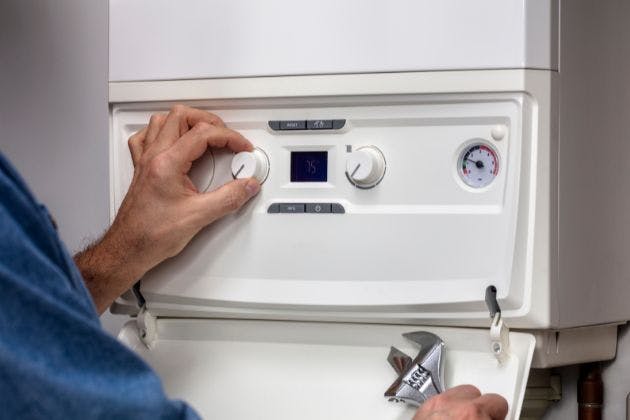
Staying safe before you touch anything
Boilers involve gas, electricity and hot water under pressure, so safety comes first. You should never remove boiler covers, tamper with gas pipes or try to fix internal parts yourself.
If you smell gas, see scorch marks, or hear a loud banging noise from the boiler, turn it off at the mains, ventilate the area, and contact a Gas Safe registered engineer immediately. Do not relight or reset the boiler in these situations.
First checks that apply to any boiler type
Whether you have a combi boiler or a system boiler with a hot water cylinder, a few basic checks are useful. These do not involve tools or opening the boiler and are safe for most homeowners to try.
Controls and programmer: Make sure hot water is actually turned on and not set to “off” or “holiday” mode.
Room and cylinder thermostats: Turn them up a few degrees to see if the boiler responds.
Boiler power: Check the fused spur switch is on and no breakers have tripped on your consumer unit.
Pressure gauge: On sealed systems, look for around 1.0 to 1.5 bar when cold. Very low pressure can stop the boiler working.
Other gas appliances: If your gas hob or fire also will not light, there may be a wider gas supply issue.
If any of these checks reveal an obvious setting issue, correct it and give the boiler 10 to 15 minutes to respond before trying the hot taps again.
Working out which boiler you have
Combi boilers heat water on demand with no separate hot water cylinder. When you open a hot tap, the boiler should fire straight away.
System or regular boilers heat water in a separate cylinder, usually in an airing cupboard. You may see a time clock labelled “hot water” and “heating” separately.
Knowing which type you have helps narrow down the cause and gives you clearer information to share with your engineer.
No hot water but heating works
Checks on a combi boiler
If your radiators are getting hot but taps are cold, the boiler is likely working for heating but not for hot water. On a combi, a common cause is a faulty diverter valve, which directs heat either to radiators or to your hot water.
You can safely check that the boiler actually “sees” a hot water demand. Turn the heating off at the controls, then run a hot tap fully open. Watch the boiler display: it should light up, show a flame symbol or a temperature rise. If nothing changes, a sensor or internal switch could be at fault and needs a Gas Safe engineer.
Checks on a system boiler with cylinder
If your heating works but taps are cold, focus on controls and the cylinder. Check the programmer has hot water set to “on” or “timed”, not “off”.
Next, find the cylinder thermostat on the side of the tank and ensure it is set around 60 °C. Turn it up slightly until you hear a click, which means it is calling for heat. If the boiler still does not fire, there may be a problem with the motorised valve or controls that needs professional attention.
Neither heating nor hot water working
If nothing is working, the issue is usually more central. Start with the basics: check the boiler display for power, any error codes, or flashing lights. Confirm the electrical supply is on and that the pressure gauge is not at zero.
Most modern boilers have a reset button or procedure in the user manual. It is normally safe to perform a single reset if the manufacturer allows it. If the boiler repeatedly locks out or the same fault code returns, stop resetting and call a Gas Safe engineer, as the boiler is telling you there is a deeper issue.
If other gas appliances in your home are also not working properly, contact your gas supplier or a Gas Safe engineer rather than repeatedly trying to light or reset things.
Hot water is intermittent or cuts in and out
Likely causes on combi boilers
Intermittent hot water on a combi can point to a partially sticking diverter valve, a scaled-up plate heat exchanger, or a temperature sensor that is giving unreliable readings. In hard water areas like much of Hertfordshire, limescale build-up is very common.
As a homeowner, you can note when the problem happens. For example, does it only occur when someone is running another tap, or when the boiler is also heating radiators? This pattern is very useful for your engineer but the actual repairs must be left to a professional.
Intermittent hot water with cylinders
With a hot water cylinder, intermittent supply can come from a faulty thermostat on the tank, an issue with motorised valves, or the programmer dropping in and out.
Check the time settings on the programmer match your routine and that the clock has not slipped after a power cut. If timings look fine, it is best to get the wiring and valves checked by a qualified engineer rather than trying to trace them yourself.
Hot water only lukewarm
Lukewarm water can be caused by the boiler not reaching its target temperature, a scaled heat exchanger, or controls limiting the temperature. First, check the boiler’s hot water temperature setting on the front panel is not set too low.
On cylinder systems, confirm the cylinder thermostat is not turned down below 50–55 °C. If settings look sensible and the water is still weak or tepid, limescale or flow issues are likely, especially in areas like Hoddesdon, Ware and Hertford, and these need professional descaling or part replacement.
Quick checks: when to call a Gas Safe engineer
There are clear signs that it is time to stop troubleshooting and pick up the phone:
Any smell of gas, sooting, or scorch marks around the boiler
Repeated lockouts or the same error code after a single reset
Leaking water from the boiler casing or visible pipe joints
Strange banging, whistling, or gurgling noises you have not heard before
Boiler covers would need to be removed to investigate further
In these cases, it is not safe or sensible to carry on testing things yourself.
What to tell the engineer for faster diagnosis
When you book a visit, a bit of clear information helps your engineer arrive prepared. Before you call, jot down:
Whether you have a combi or a system boiler with a cylinder, what the exact problem is (no hot water, lukewarm, intermittent), any error codes on the display, and whether the heating is affected. Also note any recent changes, such as pressure losses, noises, or boiler resets you have tried.
Sharing these details can save time on site and often speeds up getting your hot water back up and running.
Next steps for reliable hot water
If your hot water keeps playing up, even after basic checks, it is a sign your boiler or controls need professional attention. Recurring faults are often due to worn parts, limescale or sensors drifting out of range, and these usually respond well to proper repair and servicing.
For friendly, expert help with boiler repairs or a thorough boiler service in Hoddesdon, Ware, Hertford and across Hertfordshire, contact S&G Plumbing & Heating Solutions Ltd on 07943985998. If your “no hot water” problem keeps returning, it is worth booking a service to catch the root cause before it turns into a complete breakdown.